By: caterina daniela mora jara
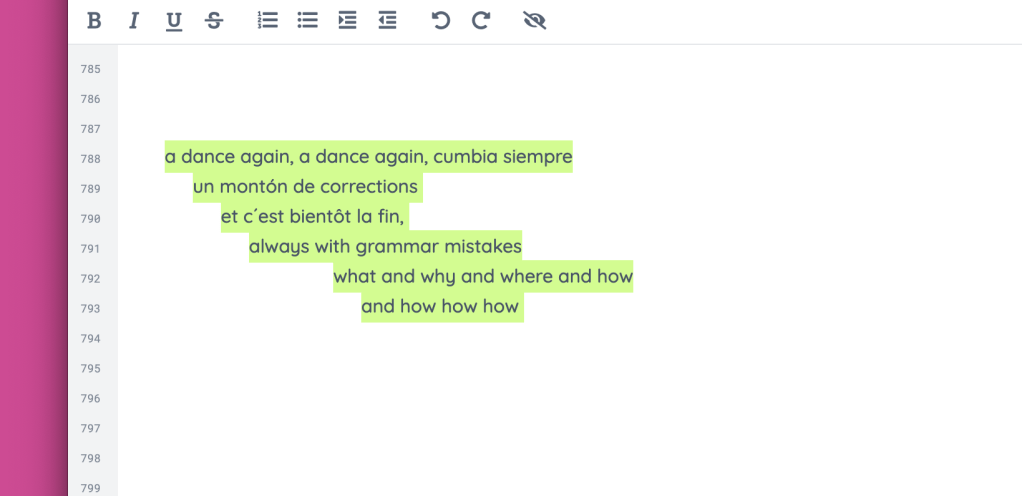
It is December 2, 2023, Dia Nacional do Samba (National Samba Day) in Rio de Janeiro, Brazil. It is 6.37 pm and we are in Rio’s main train station. The station is huge, and we are looking specifically for the Trem do Samba[i] (Samba Train). We are alone. We could say that “I” am alone, but for some time now we have decided to use the pronoun “we” for this artistic research[ii]. The use of “we” refers to a split “I”, or a multiplied “I”, because our ”I” is more than one and is constantly being negotiated. This article will explain how this “we” came about and what Chasing Dances, as an artistic methodology, means for this artistic research.
We have a rice bag in our backpack and feel ready to board the samba train. We get the ticket in exchange for a non-perishable food item, so we have bought rice. Unfortunately, when we got to the ticket counter in the station, they tell us that our rice is only half a kilo. We are embarrassed, it is too little. We give them the half kilo of rice, and then we realize that we can buy a ticket for the Trem do Samba. If we remember well, we paid 5 reais. We board the train after following a crowd of people. We pick a random carriage that is waiting to depart soon. The time doesn’t match the one we understood, but that’s no longer a problem because we’re on the train. The train is full of people, we are standing close together, there are people drinking beer at the entrance to the carriage, we have bought a beer, it is almost summer, and the air is very hot. We are all sweating. Once inside, we head towards Madureira, one of the neighborhoods where samba emerged and which is mostly inhabited by working class families and is an intense commercial area.
The moment the door closes, the train becomes another drum for the samba being played there. We almost didn’t notice, but in this carriage, in fact in every carriage, there is a different samba group. People are singing, drumming and dancing so that the train moves slowly forward, but mostly from side to side, in irregular shaking, and we even have the feeling that we could be going backwards. Sometimes the vibration is so strong that we only know we are going forwards because when we look out of the window, we can confirm that we are going forwards. The feeling of festivity and celebration is huge. Our songs move the train in so many directions that it is better to dance and follow the movement of the train than to try to stay in one fixed place and collide with the border of the wagon. We don’t recognize the sambas being played, only the song Meu lugar by Arlindo Cruz[iii], which sings about the Madureira neighborhood.
When we arrive at Madureira station, there are thousands of people on the grounds, three large scenes, many rodas de samba in the streets. The event takes over the whole neighborhood and we stand right next to people’s houses. We walk through the streets and chase after the sambas. We do this for many hours until it’s difficult to get back to the center of Rio de Janeiro, and after trying for an hour, we finally come back with an Uber.
We chase dances. Our goal is to capture them alive and keep them alive. We know that we cannot chase after them to have or possess them, so we are also careful not to kill them. Our chase always implies an object in motion: dances. Dances like to be in constant movement, they run away, and we enjoy this process of approaching and embracing this closeness. As we practice chasing, we study the dances that we later want to perform in other contexts: how the bodies host the dances, what are the repeated patterns, the key leaps and accents, what is the distance between people, how is space being used. It is a careful endeavor to keep dances alive so that they can later be alive in other contexts. It’s important to pay attention to the exact times, spaces and specific outfits that these dances require. Dances are slippery, and they are adept at disguising themselves. The dances we like best are surprising, explosive, chaotic. But we also like the dances that are a bit boring, predictable and regular. Chasing dances can be seen as an insistence on the creation of experiences, on the search for contexts in which bodies inhabit dances. And we do not hesitate to affirm this: we chase dances because we love to dance.
How do we chase dances? We move towards them, which means that we chase dances as a relational exercise: in relation to other people, spaces, entities. As we chase dances, my body, our body, tries to replicate a multiplicity of bodies that move. This is what we look for at dance lessons, dance session, dance events, live concerts with dance and/or on the street. On the way from a dance lesson to a dance that could happen on the street, we have discovered a fascination for the minimal unit of dance: the steps. In English we say “step”, like the smallest unit of walking, in Spanish we say paso.
Depending on the dance tradition, we can find different ways of approaching the steps. So, when we chase dances, we also learn how to embody these steps. For some dances, we try to understand not only how the dance is being danced, but also what is the sensation in terms of the proximity, sociality and endurance this dance evokes.
Like samba, there are some dances whose main aim is to vary the same step in rhythm, intensity, direction, accent and space, to name but a few parameters.
There are also other dance forms where there are no specific steps, but certain ways of approaching the rhythm while walking the steps. Cumbia, for example. We can debate whether cumbia has certain steps or not, and it all depends on what kind of cumbia we are talking about. There is even a cumbia villera song (Alabarces and Silba, 2014) called Tirate un paso by Los Wuachiturros[iv], which could be translated in English as “Through a step”, for which a specific step has been developed. Anyhow, if there is cumbia around ourselves, there is a feeling of belonging that comes up. When we’re in Europe, we play cumbia on YouTube and we chase it with my cat in the kitchen. We are trying to establish a relationship between my body, my cat’s body and the music. Cumbia in the hips and shoulders, circles, bouncing with rhythm. Usually in a large group, not often in a duo configuration. We miss cumbia when we are in Europe and when we are in Argentina, we don’t have to look for it. We come across cumbia all the time: in the radios, in the street, in any waiting room. Dancing cumbia is more a way of being in life rather than something we have to seek.
Chasing dances is determined by the context in which we are. Sometimes it is more difficult to chase dances than others. Even more, there are dance forms that have specific ways of denoting a specific movement and ballet is specialized in that. For example, there is a ballet step called chassé, which means “chased” in French. In chassé, one leg chases the other in a continuous movement that always provokes a negotiation of the entire body axis between balance and imbalance, and so on. There are many chassé variations that can be performed in different directions and degrees of difficulty, including turns and jumps.
In ballet, chassé can start from fifth position. Begin by bending both legs in a demi plié, then slide one foot in one direction, let’s say forward (but it can be sideways or backwards), while shifting your weight between both legs. Deepen the plié and shift your weight forward. Shift your weight further onto the front leg while straightening both knees. The second leg chases the first. The mechanism must flow together from the starting position to the end position as a continuous movement and always ends with a generous plié, a bending of the knees because it requires a firm base, as the next step is performed from there. Even if chassé can be used as a connecting step, that is, as a chassé, as a unit, one chassé is not enough to convey the image of chassé. To convey the image of movement in space, chassé requires several successive units of the same step. We chase dances with the same intention that is needed to perform chassé: chasing one leg after the other, in persistent movement.
Chasing dances looks for the experience of pleasure in dancing. It started as a regular practice more than ten years ago, when we returned to dancing after a long break. Over the years of our PhD in artistic research, however, it became increasingly clear that this way of engaging with dance follows a performative program[v]. And here it is: Wherever you are, chase the dance that might be happening around you. In cities it’s extremely advisable to chase dances, in the countryside it’s a bit difficult, but not impossible. When you start chasing dances, you try to get involved in the social environment, you talk to people, ask for details about the dance and other places to continue chasing dances. Over time, the regular practice of chasing dances has developed into a specific artistic methodology.
When we use the word “chase”, we use it in the sense of driving or sending out by force, and we are chasing after the goal of dancing. However, we know that “to chase” can also mean to run after a person or an animal, and that there is a full spectrum of dispositions associated with it, this is, the act of chasing also determines that something can be chased.
Therefore, we know the verb “to chase” in the country we come from, reproduces the national colonial idea of chasing people to kill them or drive them off the land they live on. The verb “to chase” and the idea surrounding the term can be associated with colonial enterprises of appropriation, removal, destruction and death. So, if this term is historically associated with this, is it possible to give chasing dances a connotation that challenges the colonial association that the word may imply?
Our hypothesis is that we chase dances for the thrill of chasing rather than the thrill of catching. Since our goal lies in movement, we are interested in chasing as an impulse and as a poetic operation. By chasing dances, we want to feel grounded in the territory we are in, because we long for the dances of the territory we come from.
In the words of Daniel Blanga Dubai: “Dance is a movement in which the bodies occupy the movement” (2020). So, there is a life in dance that precedes, exceeds and goes beyond our own body that practices this dance. In other words, samba exists outside of us, it has preceded us and will continue to exist without us. And every dance organizes a specific collective thinking, that is supra-individual and shared by the moving bodies. We chase dances to experience how steps arrange themselves before, after and in between other steps. We chase dances to be part of temporary communities.
As migrants from Argentina and Chile, we crave cumbia and are curious about dances that bring us joy. But what happens when it is hard to find dances where you feel pleasure? For instance, we don’t like electronic music, we almost hate it, we can’t listen to it, we can’t enjoy the social instance where this music is played. In Europe, we have felt very isolated by electronic music, the whole culture that surrounds it. The rave culture, that is so famous in Sweden, reinforces this longing. Where could we dance? It is not so easy, but we’d like to share some chases from the last four months.
We have already said that we chase cumbia in our daily lives, but it is difficult to find it in a party in Europe. The dance that is the easiest for us to chase is tango. Since I grew up with it, I identify with it. In Europe, tango has become a dance where we can feel a sense of belonging. But it is difficult to engage with it in Europe, the tickets for tango events are very expensive. The tango we chase is the one with a tight embrace, with not too many steps and with a deep interweaving of weights. A tango that can go until 5 o’clock in the morning. However, it’s hard to dance tango at 5am in Europe. In recent months, it has become increasingly difficult for us to dance tango in Europe at all. Not long ago, in June 2025, we did it in the Tango queer community in Stockholm, but after dancing again in Argentina (March and April 2025), we find it hard to chase tango again in Europe.
However, it is easier to chase tango than reguetón, another dance which we enjoy. Tango is usually spread via Facebook, a social network that we still use. Information about reguetón, on the other hand, is usually spread via Instagram, a social network that we don’t use. So, when it comes to reguetón, it’s important to ask people on the streets, in restaurants, in bars, and in any store: where can we chase reguetón?
We look for these dances in the cities we go because, as dancers with a migration background, we long for these dances. But because we are also curious about how dances manifest themselves abroad, we spend lots of time looking for dances in every new environment.
In all the contexts where we have chased dances, we don’t ask permission and just go with it. We put ourselves in the situation of chasing dances, but we don’t explain it too much to the people around us. We are curious about the sensation that dances convey, it is a subjective, personal and contextual experience: context and experience have no boundaries, they are interrelated in the task itself.
The curiosity to chase dances led me to a strip club. Here, too, we repeated the same methodology of chasing dances, this time stripping. In this context, the complex processes of commodification and eroticism had implications and consequences for this artistic research. Everything exploded: my own person, my own voice as an artist, the status of the work and the questions of ethics in artistic research.
To enter the space of the strip club, I was required by the management to use a name other than my own. I was required to not be “caterina”. I had to create another ”I”. The necessary “I” then entered a battle with the “I” of the artistic research. I was no longer just one person, but we were three, because between the person of the researcher and the person of the stripper, another persona became necessary for the public space. Stripping made the fissure in our selves; the singular became three as an experience of the self that must adapt to different contexts. The splitting of the “I” is the most important result of this experience.
Over time, we have adopted this “we” to refer to the crossing of boundaries, so that we chase dances to cross the boundaries between dance forms, styles and techniques as a strategy to enjoy the pleasure of dance, which for us always happens when there is more than one. The “we” has increased the friction in positionality towards our artistic methodology: We chase dances to deal with the tensions between dances by creating spaces for negotiating steps, hand turns and mingling. We chase salsa, samba, malambo, tango, ballet, somatic practices, house, bomba, plena, striptease and so on. We chase to be danced by the dances, to bring them together later and to raise the temperature of our bodies. By letting ourselves be danced by the dances in a continuous mashup, we eroticize our research.
References
Alabarces, P. and Silba, M (2014). “Las manos de todos los negros, arriba”: Género, etnia y clase en la cumbia argentina. In Cultura representaciones soc, Vol.8, n.16, pp.52-74. Retrieved on 16 August 2025 from https://www.scielo.org.mx/pdf/crs/v8n16/v8n16a3.pdf
Blanga Gubbay, D (2020). Being Danced by the Dance. In DiVersions. Retrieved on 14 August 2025 from https://diversions.constantvzw.org/wiki/index.php?title=Potential_authorship&
Fabião, E (2013). Programa performativo: o corpo-em-experiência. In Revista do LUME, UNICAMP. Vol. 4 from https://orion.nics.unicamp.br/index.php/lume/article/view/276
[i] It is possible to access the program of the 2023 edition via this link: https://en.prefeitura.rio/cultura/no-dia-do-mais-tradicional-ritmo-musical-brasileiro-trem-do-samba-comemora-com-muita-musica-da-central-do-brasil-a-oswaldo-cruz/
[ii] We are a doctoral student at Stockholm University of the Arts: https://www.uniarts.se/english/research-and-development-work/phd-project/phd-project-by-caterina-mora/
[iii] Written by Arlindo Domingos da Cruz Filho and Jose Mauro Diniz, released in the album Mtv Ao Vivo Arlindo Cruz, Cd 1, 2009.
[iv] Written by Hector R. Ruiz-morales; released in the album Tirate Un Paso, 2011.
[v] Here we follow the concept of programa performativo [performative program] by Eleonora Fabião which proposes a catalyser of experience (in her words: “um ativador de experiência”), in which the artist’s intentions, expectations and actions can be framed as a critical tool for reactivating the conditions of experience.
About the author
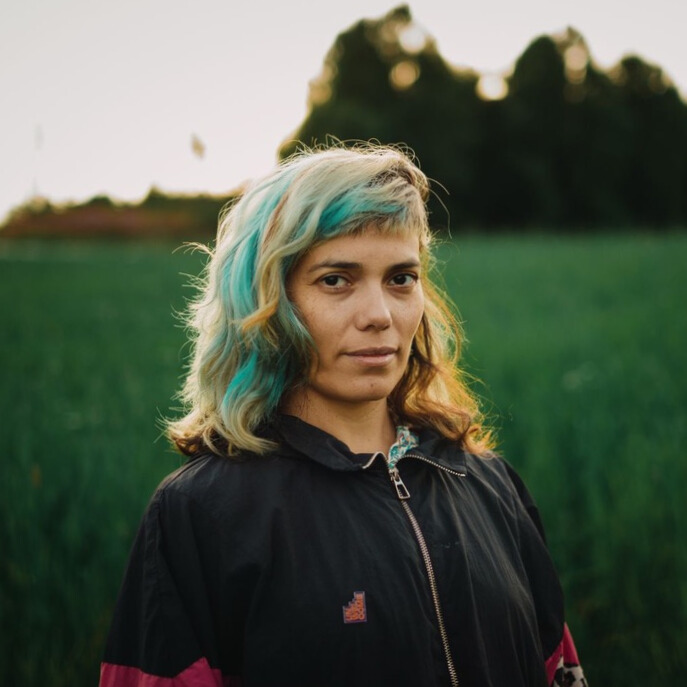
caterina daniela mora jara is a performing artist and researcher from Fiske Menuco (Wallmapu) and currently a PhD student at Stockholm University of the Arts. Her work aims to problematise modes of production and the colonial legacy in dance practices. She got married to have a residency permit on European territory. She has no Instagram account and has never been to an IKEA store.
 Antroperspektiv
Lämna en kommentar